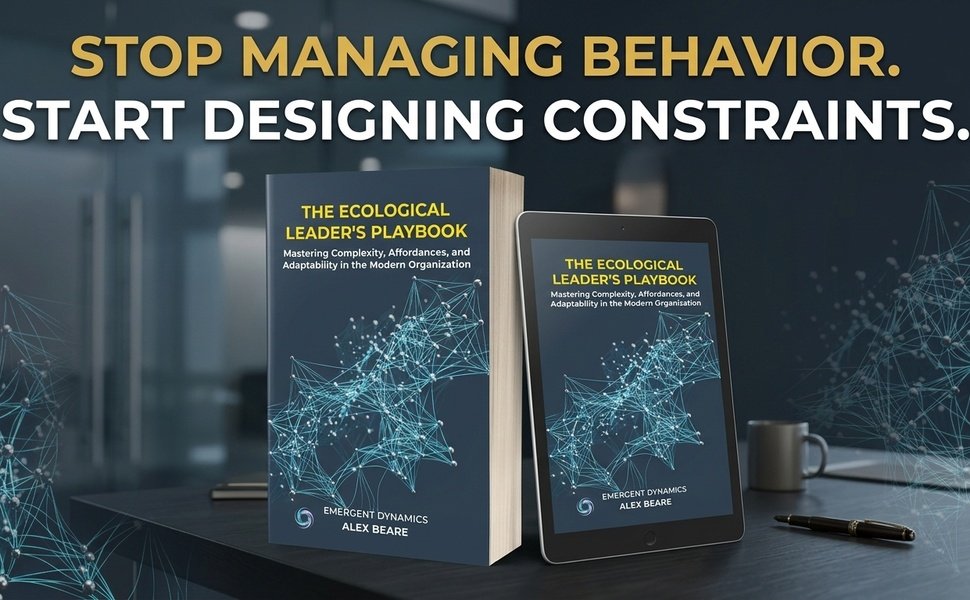
 Official Publication • Available Now on Amazon
The Ecological Leader's Playbook
Stop Managing People. Start Designing Environments.
A scientific operating manual for CEOs, Founders, and VPs to dismantle organizational friction, dissolve departmental silos, and replace top-down micromanagement with self-organizing architectures.
Linear Management vs. Ecological Leadership
Traditional business management treats companies like mechanical clocks with interchangeable cogs. When problems occur, leaders add layers, reassign reporting lines, or mandate motivation workshops. Ecological leadership changes the actual operational landscape.
| Operational Dimension | Traditional Linear Management | Ecological Leadership (CLA) |
|---|---|---|
| Primary Control Lever | Prescriptive SOPs, top-down policies & direct micromanagement | Task, Environmental & Individual Constraints that guide behavior naturally |
| Problem-Solving Focus | Diagnosing "defective employees" or changing reporting lines on org charts | Affordance Architecture: Redesigning information flows and feedback loops |
| Cross-Team Alignment | Isolated departmental silos with heavy cross-functional meeting overhead | Dynamic Shared Landscapes: Real-time perception-action coupling between teams |
| Resilience to Market Shocks | Fragile single-point dependencies; paralysis when key leaders are absent | Functional Degeneracy: Different team configurations achieve identical outcomes |
| Decision Speed | Multi-tier executive sign-offs, delayed escalations & bureaucratic lag | Distributed Frontline Agency: Rapid execution governed by clear boundary charters |
Three Core Pillars of Ecological Leadership
The playbook translates four decades of non-linear ecological science into battle-tested management heuristics:
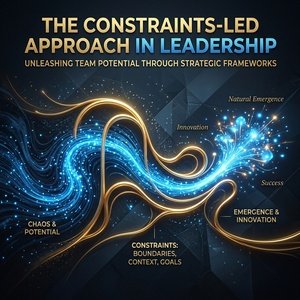
The Constraints Model
Shape team behavior and unlock high performance by tuning Task, Environmental, and Individual boundaries—eliminating coercive supervision.

Affordance Landscapes
Design shared corporate work spaces where strategic opportunities, risks, and next actions are directly perceived and acted on in real time.
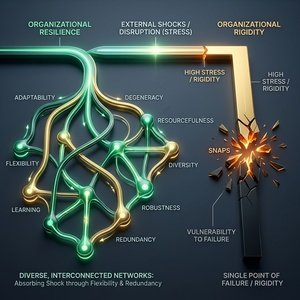
Degeneracy Over Fragility
Build robust enterprise systems where multiple distinct sub-teams can solve the same strategic crisis without single-point operational bottlenecks.

What You Will Master in This Playbook

Representative Task Design
Replace sterile policy meetings with high-fidelity project simulations that expose teams to realistic market friction and customer feedback loops.

Attractor State Tuning
Identify deep-seated organizational dysfunctions (attractor basins) and apply micro-nudges to guide teams into high-velocity operational rhythms.

Perception-Action Coupling
Connect information directly to execution. Eliminate lengthy memo-writing and committee approvals by coupling frontline signals with autonomy.
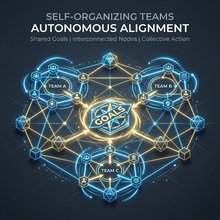
Self-Organizing Systems
Build cross-functional pods that synchronize organically when market conditions change, without requiring senior executive intervention.
Complete Chapter & Curriculum Architecture
A structured, 4-part progression designed for rapid implementation in executive workflows:
The Mirage of Control: Why Mechanistic Leadership Fails
Deconstructs why traditional top-down management models collapse in complex, uncertain markets. Introduces complex adaptive systems, non-linear dynamics, and Newell's Constraints Triangle for organizational systems.
- Chapter 1: The Clockwork Illusion & The Cost of Micromanagement
- Chapter 2: Understanding Complex Adaptive Systems in Corporate Contexts
- Chapter 3: The Newell Triangle: Task, Environment, and Individual Constraints
The 3 Core Levers: Engineering Constraints
A tactical guide to manipulating operational boundaries. Learn how to tune task specifications, environmental information architecture, and individual competencies without prescribing rigid action steps.
- Chapter 4: Task Constraints: Redefining Goals, Rules, and Deliverable Boundaries
- Chapter 5: Environmental Constraints: Information Architecture and Communication Flow
- Chapter 6: Individual Constraints: Unlocking Latent Cognitive & Skill Capabilities
- Chapter 7: Boundary Calibration: Finding the Sweet Spot Between Chaos and Stagnation
Affordance Landscapes: Designing Actionable Workspaces
How to create shared physical and digital environments where strategic opportunities are obvious and immediately actionable. Eliminate the cognitive friction that creates departmental inertia.
- Chapter 8: The Science of Ecological Perception and Gibsonian Affordances
- Chapter 9: Mapping Corporate Affordance Landscapes Across Siloed Teams
- Chapter 10: Shared Information Spaces: Visual Management & Real-Time Feedback
- Chapter 11: Perception-Action Coupling in Fast-Moving Product Teams
The Self-Organizing Enterprise: Field Implementation
Turn theory into organizational reality. Complete step-by-step diagnostic audit frameworks, 14-day meeting elimination protocols, and executive boundary charters.
- Chapter 12: The Constraints Audit Protocol: Identifying Friction Hotspots
- Chapter 13: The 14-Day Meeting Elimination Blueprint
- Chapter 14: Establishing 4-Tier Decision Boundary Charters
- Chapter 15: The Adaptive Leader's Long-Term Wayfinding Guide
Engineered Specifically for High-Stakes Leaders
CEOs & Founders
Scale your company beyond your personal bandwidth without creating bureaucratic bloat or losing agile responsiveness.
VPs of People & OD
Replace superficial team-building exercises with systemic environment designs that foster natural collaboration.
Agile & Org Architects
Move beyond rigid Scrum/Agile rituals to true non-linear self-organization grounded in complex systems science.
Addressing Your Executive Questions
Q: How is Ecological Leadership different from standard Agile or Holacracy?
Standard Agile and Holacracy often introduce rigid ceremony checklists, mandatory meeting cadence, and heavy governance rules that create their own administrative friction. Ecological Dynamics operates at a deeper layer: it manipulates physical and information constraints so self-organization emerges organically without enforcing arbitrary rituals.
Q: Will this work in highly regulated or traditional corporate environments?
Yes. Regulatory compliance and security requirements are simply treated as non-negotiable Boundary Constraints. Within those defined guardrails, teams have complete freedom of movement, unlocking speed and agility without violating compliance standards.
Q: How quickly can our leadership team see measurable operational results?
By applying the Part IV diagnostic audit and the 14-day meeting elimination protocol, most executive teams reduce non-essential meeting hours by 30–40% and notice faster cross-functional decision cycles within two weeks of deployment.
Q: Do I need prior background in systems science or sports pedagogy to understand this?
Not at all. While the book is scientifically grounded in ecological psychology, every single concept is illustrated with real-world enterprise case studies, visual diagrams, and concrete leadership heuristics written in clear business language.
Ready to Stop Managing People and Start Designing Environments?
Order your copy today on Amazon KDP for $9.99 USD with instant Kindle delivery and global paperback shipping.