 Active Manuscript Revision • Early Access
The Adaptive Athlete
A Coach's Guide to Skill Adaptation and Environmental Design
From Prescriptive Instruction to Adaptive Mastery.
The definitive guide for football (soccer), basketball, and invasion sports coaches to transition beyond isolated routines into Representative Learning Design (RLD) and the Constraints-Led Approach (CLA).
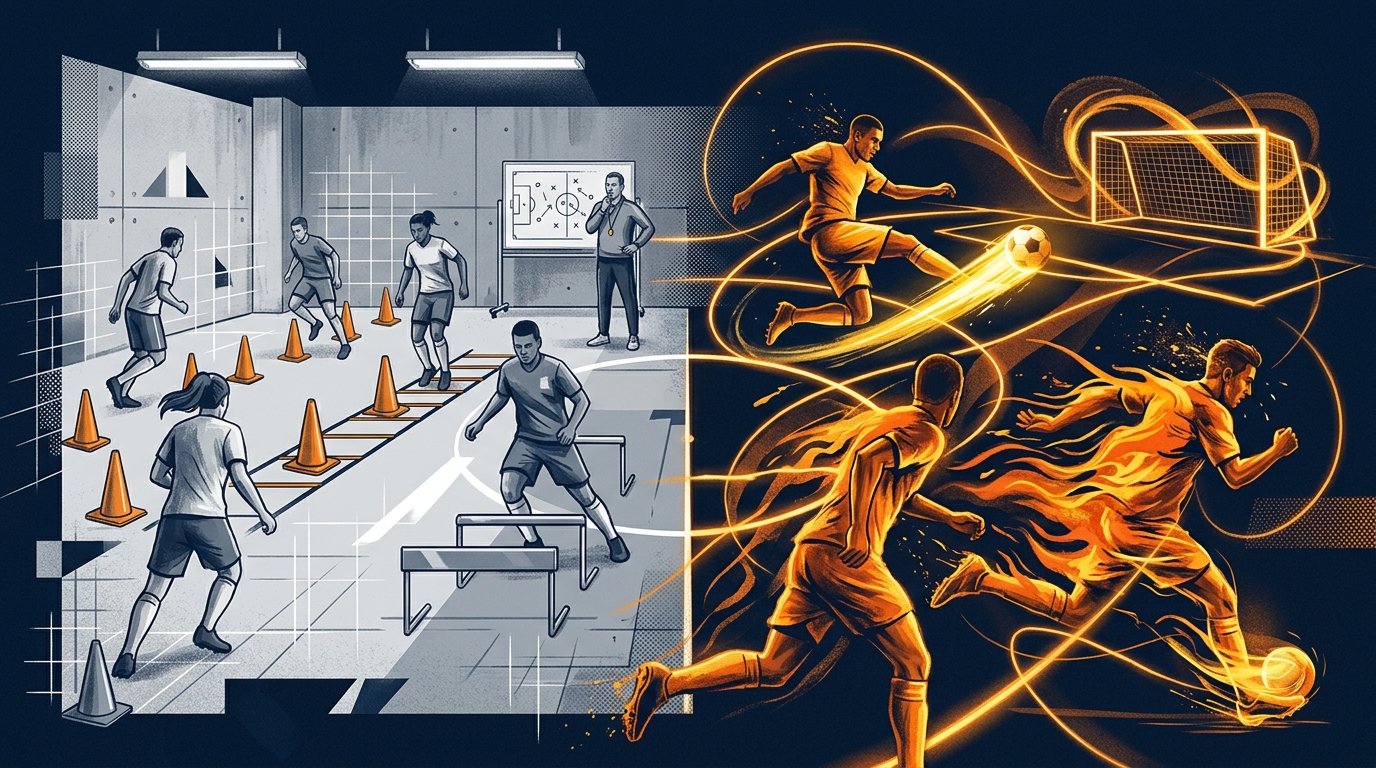
Prescriptive Coaching vs. Constraint-Led Ecological Coaching
Why does training ground execution sometimes break down under match pressure? Because isolated routines separate movement from the live informational cues of the game.
| Coaching Dimension | Prescriptive Instruction Model | Ecological Dynamics & CLA |
|---|---|---|
| Training Focus | Isolated technique repetitions separated from match context | Representative Learning Design: Dynamic opponents, real perceptual information & directional goals |
| Ideal Movement Model | "One Ideal Technique" that all athletes must replicate identically | Movement Degeneracy: Encouraging diverse, individualized movement solutions for the same outcome |
| Decision-Making | Pre-scripted exercise routines; explicit verbal step-by-step instructions | Affordance Attunement: Players perceive live spatial opportunities and execute autonomously |
| Role of the Coach | Prescriptive instructor providing direct mechanical corrections | Environmental Architect: Designing task constraints that let skill emerge naturally |
| Matchday Transfer | Low: The "Illusion of Learning" collapses when real defenders apply pressure | High: Athletes develop robust perceptual-motor adaptations tested against chaos |
The Science of Skill Emergence on the Pitch
Perception-Action Coupling
Movement is meaningless without information. Learn how to preserve realistic optical information flows in every training session.
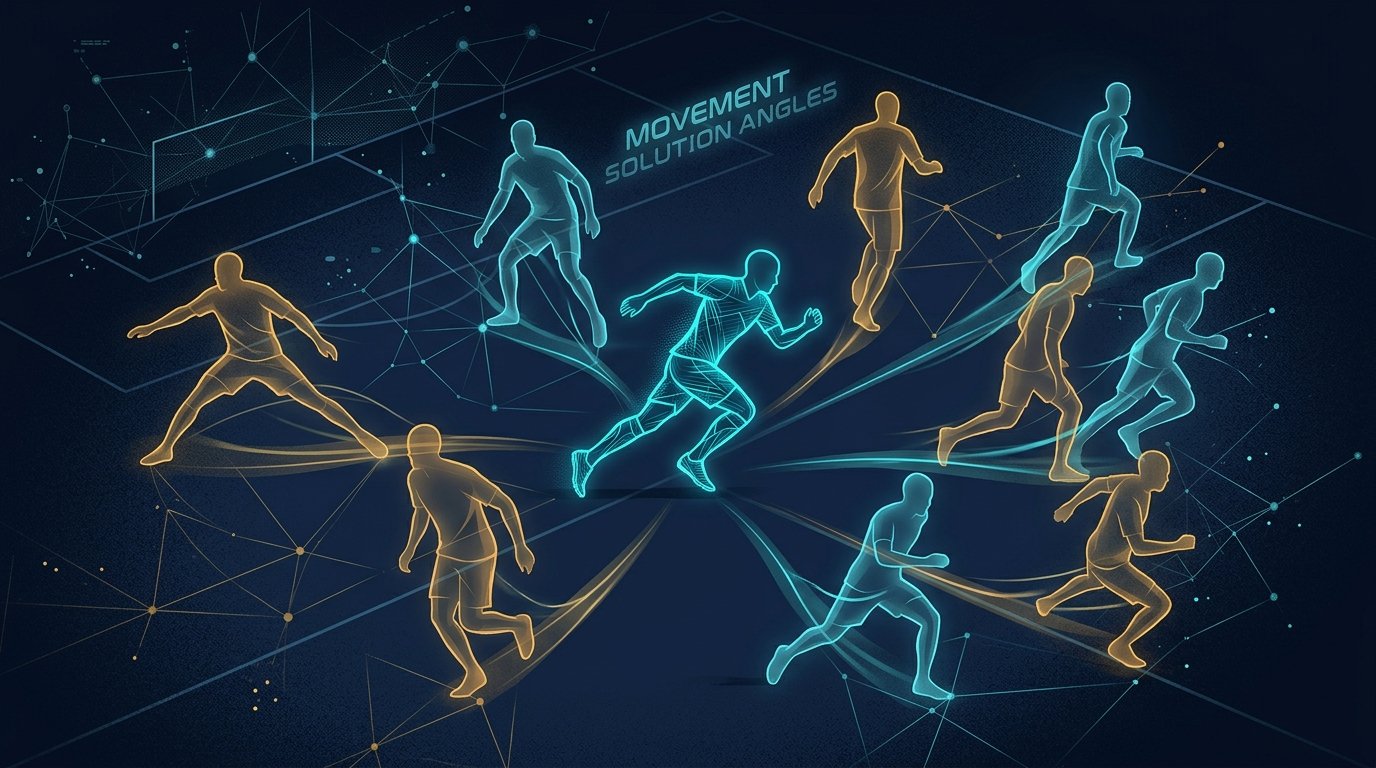
Expanding Search Space
Manipulate spatial boundaries, pitch geometry, and numerical relations to guide players to discover novel tactical affordances.

The Environmental Architect
Transition from prescriptive instructor to learning architect. Shape player development through environmental design rather than constant micromanagement.
Inside The Adaptive Athlete: 4 Core Modules
The Illusion of Transfer: Bridging Practice to Match Day
Deconstructs the cognitive-mechanistic paradigm in sports science. Explores why isolated technical repetitions create the feeling of proficiency in practice but struggle to transfer to chaotic matchday situations.
- The perception-action de-coupling challenge in isolated training routines
- Direct Perception: Gibsonian Ecological Psychology applied to invasion sports
- Why "muscle memory" is a biological myth
The Constraints-Led Approach (CLA) in Practice
A hands-on manual for manipulating Newell's Triangle on the training pitch: Task Constraints (rules, goals, pitch dimensions), Environmental Constraints (surface, weather, crowd noise), and Individual Constraints (fatigue, limb dominance).
- Designing task constraints that trigger specific tactical behaviors without verbal instruction
- Scaling pitch geometries to alter decision-making time and spatial affordances
- Using asymmetrical overloads (e.g. 4v3, 3v3+2) to stimulate perceptual attunement
Affordance Landscapes & Wayfinding on the Pitch
Athletes do not process data like computers; they perceive invitations for action (affordances). Learn how to train players to read live passing lanes, defensive body postures, and spatial gaps under high cognitive load.
- Shared Affordances: Creating non-verbal synergy across defensive and attacking lines
- Wayfinding: How elite playmakers navigate dense defensive blocks
- Attunement and calibration: Training players to adjust their movement to ball velocity and teammate speed
Designing the Adaptive Academy
A macro-level blueprint for Academy Directors and Technical Directors to structure club-wide curricula around Ecological Dynamics, transitioning toward game-representative learning environments.
- Club curriculum redesign: Transitioning from rigid exercise templates to representative practice designs
- Coach education heuristics: What to say (and what NOT to say) during practice intervals
- Matchday observation pads: Evaluating player adaptation over rote technical execution
Designed for Forward-Thinking Sports Practitioners
Invasion Sports Coaches
Football (soccer), basketball, rugby, and hockey coaches looking to build high-IQ players who solve problems in real time.
Academy Directors
Technical leaders seeking a coherent, science-backed methodology across all youth development age groups.
Skill Acquisition Specialists
Applied sports scientists and S&C professionals bridging motor learning research with pitch-side practice design.
Frequently Asked Questions
Q: Does the Constraints-Led Approach mean players receive no technical instruction at all?
No. Technique is crucial, but in CLA it is always trained within a functional, information-rich context. Instead of giving prescriptive movement templates, the coach constrains the task so the athlete's body self-organizes the most biomechanically efficient solution for that specific scenario.
Q: Can CLA be applied to young grassroots players (U8–U12)?
Absolutely. In fact, children thrive under CLA because it resembles natural play and street football, fostering natural movement exploration and intrinsic motivation through dynamic, game-like problem solving.
Q: How is this book different from existing tactical coaching manuals?
Most coaching books provide static diagrams with arrows showing where players "should" run. *The Adaptive Athlete* teaches you how to design environments where players organically discover those spaces themselves, cultivating genuine decision-makers.
Transform Your Coaching Practice Today
Start by taking our free 3-minute Coaching CLA Diagnostic Audit, or explore The Ecological Coach's OS on Lemon Squeezy.