The Architect, Not the Answer-Man: The Identity Shift That Changes Everything

The most important change in your coaching career isn't a new drill or a new formation. It's a shift in who you believe you are on the training ground. When you stop seeing yourself as the person who holds the answers and start seeing yourself as the designer of the environment where answers emerge, everything downstream changes.
You've felt the weight of it. Saturday's opponent is set, the team is circled around you, and ten pairs of eyes are waiting for the solution. Your instinct — honed by every coach who ever shaped you — is to deliver it. To draw the line, name the run, prescribe the fix. You are the Answer-Man. It's the role you were trained for, the role that earns respect on Monday-morning touchlines.
But here is the hard truth: the moment you become the Answer-Man, you become the bottleneck. Every solution your players find is borrowed from you. The day you're absent, the solutions stop. The tree you've been watering can't grow without your hand on the hose.
You might be thinking: But if I'm not giving them the answer, what exactly am I being paid for? Isn't silence just negligence?
That fear is the last grip of the old identity. And it's worth naming, because the shift I'm describing isn't about doing less. It's about doing the work that actually moves the needle — the work that happens before anyone steps on the grass.
The Prescriber Versus the Architect
Let's be precise about the two identities, because most coaches live in the blurry middle without knowing it.
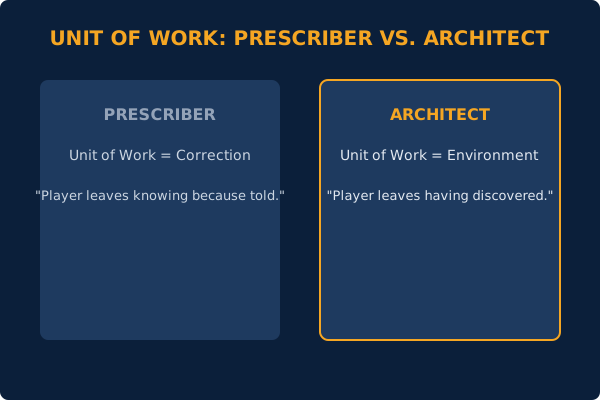
The Prescriber is the Answer-Man. He diagnoses a problem and hands over the cure. "You're drifting wide — tuck in." "Your first touch is heavy — relax the ankle." The Prescriber's unit of work is the correction. The player leaves knowing what to do, but only because the coach told him.
The Architect designs the problem. She doesn't tell the player where to stand; she shapes the space so that the right position becomes the only comfortable option. She doesn't correct the first touch; she compresses the time and space until a soft touch is the only thing that survives. The Architect's unit of work is the environment — the boundaries, the rules, the surface, the numbers. The player leaves having discovered the solution himself.
This is the core of Ecological Dynamics: skill is not delivered, it is grown. The Architect is simply the gardener who gets the conditions right and then trusts the growth.
Via Negativa: What the Architect Is NOT
To protect the shift, we have to be clear about what it is not.
The Architect is not absent. Designing a session that does the teaching is harder, not easier, than running your mouth for ninety minutes. It demands that you think before you coach, not during.
The Architect is not anti-instruction. Sometimes the clearest path is a word. The point is not silence for its own sake — it's restraint. You speak when a constraint can't carry the load, and you stay quiet when it can.
The Architect is not a mystic who "lets the game be the teacher" and hopes for the best. Hope is not a design. The Architect manipulates constraints with surgical intent — that's why it's called the Constraints-Led Approach (CLA). The environment is never accidental; it is authored.
The Scar Tissue
This shift is uncomfortable. Brutally so. I still remember the first time I bit my tongue for three full minutes while a player searched for a pass I could have named in three seconds. My ego itched. Every fiber wanted to rescue him, to be the competent expert in the room.
That urge is scar tissue — the wound of every coach who was told that value equals volume of instruction. We equate talking with teaching. We equate our voice with our worth. Letting go of that feels like vanishing.
But the players who struggle through and find it themselves? They don't forget. They own it. And the quietest sessions, the ones where you said almost nothing, are the ones they remember as the ones where it finally clicked. The Architect's reward is invisible by design — a team that no longer needs him.
The Payoff
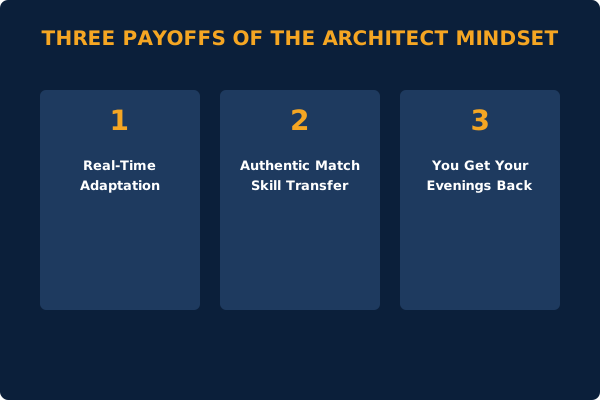
When you become the Architect, three things happen. First, your players adapt in real time, because they've practiced solving, not obeying. Second, your methods transfer to the game, because the environment you built was the game's essence, not its costume. Third — and this is the one nobody warns you about — you get your evenings back. You stop re-litigating every mistake in real time and start designing the conditions that prevent the mistake from being the only available option.
Stop being the map. Become the terrain.
The Prescriber builds dependent players. The Architect builds independent ones. Choose, deliberately, who you are before you walk onto the pitch — because the identity you bring is the first constraint your players will feel.
Stop Training Robots. Build Adaptive Athletes.
Join our community of forward-thinking coaches applying Ecological Dynamics in high-performance sports.
Explore The Adaptive Athlete