The Emergence of Movement Skill: From Technique to Problem-Solving

The most common mistake in coaching is teaching "technique" — a fixed, repeatable movement — instead of cultivating "problem-solving" — the ability to adapt and discover solutions in real time. Skill doesn't emerge from repetition of a standard motion. It emerges from the athlete’s struggle to survive within an environment designed to make the right solution inevitable.
You’ve seen it. A player drills the perfect pass for ten minutes — crisp, accurate, textbook. Then they step onto the pitch. The defender moves an inch early. The ball bounces off a puddle. The teammate cuts inside instead of wide. The "perfect" technique vanishes. The player freezes. They don’t know what to do because they never learned how to solve — only how to perform.
This is the tragedy of the "standard technique" (標準動作). We mistake the outcome of a skilled movement for the process of skill development. We think if we drill the shape, the intelligence will follow. But intelligence isn’t copied. It’s grown.
The Myth of the Standard Technique
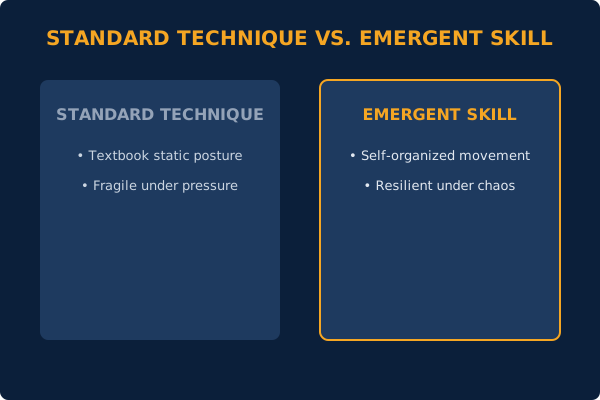
The "standard technique" is a snapshot — a single frame from a movie. It’s what the movement looks like when it works. But in the game, there is no "standard". There is only the constant, chaotic flow of constraints: the defender’s posture, the ball’s speed, the lighting, the fatigue, the noise, the pressure.
A coach who teaches "standard technique" is training the player to reproduce a static image. But the game is a living, breathing system. The player must learn to read the environment, interpret the cues, and generate a unique solution — one that may look nothing like the textbook.
[!note] TERM CARD|術語卡 > **標準動作(standard technique)**:被教練強行推廣的「正確」動作模型,常被誤認為技能的本質。與功能性、可適應的解決方案相對。 > Example: 教練要求「觸球時腳踝必須鎖死」,但比賽中,球員可能因壓力而用腳背、腳內側甚至大腿完成一記關鍵傳球。這不是錯誤,是適應。
The "standard technique" is not wrong — it’s incomplete. It’s the result of a skilled interaction, not the cause. To teach it as the goal is like showing a photograph of a bird in flight and saying, "Now go fly like this." The bird doesn’t learn to fly by copying the photo. It learns by falling, flapping, and adjusting.
The Architect’s Design: Constraints as Teachers
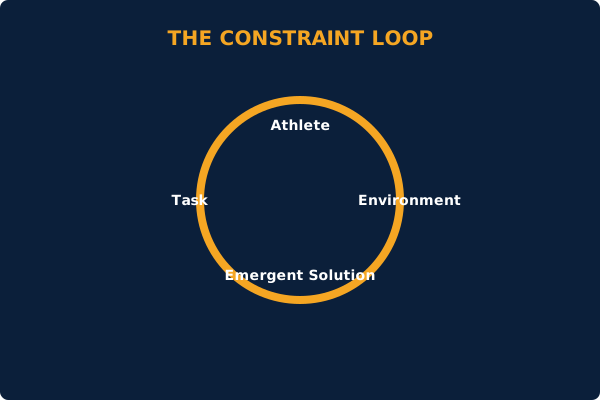
The coach’s job is not to give the answer. It’s to design the question.
To develop problem-solving skill, we don’t teach the pass. We manipulate the constraints:
- **Task Constraint**: "You must pass before the defender closes the gap."
- **Environmental Constraint**: The pitch is wet. The ball moves slower.
- **Organismic Constraint**: Players must use their non-dominant foot.
Now, the "standard" pass is impossible. The player must adapt. They might use a backheel. They might flick it over. They might pass with their heel. It doesn’t look textbook. But it works. And that’s the point.
The solution emerges — not from instruction, but from the interaction between the athlete and the environment. The constraint doesn’t dictate the movement. It shapes the search space, forcing the athlete to find a functional solution.
This is the power of ecological dynamics: skill is not taught. It is discovered.
Via Negativa: What Emergence Is NOT
Let’s be clear. Emergent skill is not:
- **Free play** — letting players do whatever they want without design. That’s chaos, not coaching.
- **Just playing games** — a 5v5 match with no constraints is just a game. It’s not a learning environment.
- **Ignoring technique** — we’re not saying technique doesn’t matter. We’re saying technique is the *byproduct*, not the *target*.
Emergence is the intentional design of a problem so complex, so rich in perceptual cues, that the only way to succeed is to adapt — to think, to feel, to solve.
The Master’s Eye
This shift is the "Scar Tissue" of the veteran coach. I remember the first time I watched a player, after five minutes of struggling, suddenly execute a pass I’d never seen before — a flick of the heel under pressure, perfectly weighted, perfectly timed. I didn’t teach it. I didn’t show it. I didn’t even say a word.
I had simply removed the safety net. I had made the textbook solution impossible. And in that space of uncertainty, the player’s brain did the work.
That moment wasn’t a success. It was a revelation.
The player didn’t learn a technique. They learned how to learn.
That’s the difference between a coach who gives answers, and one who designs problems.
Stop teaching technique. Start designing environments.
Let the movement emerge.
Stop Training Robots. Build Adaptive Athletes.
Join our community of forward-thinking coaches applying Ecological Dynamics in high-performance sports.
Explore The Adaptive Athlete