The Fidelity Gap: Why Your Training Doesn't Translate to the Game
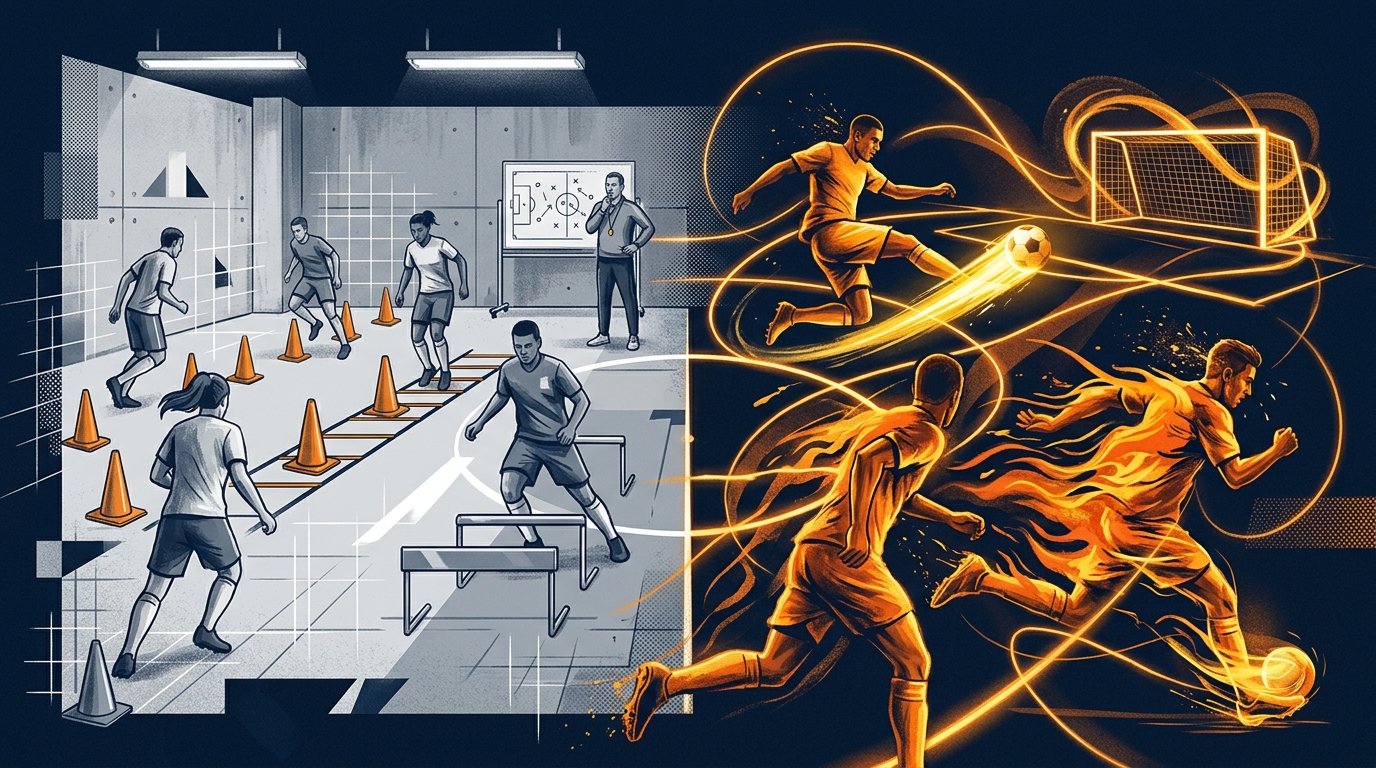
The most frustrating experience for any coach is the "Saturday Surprise"—when a player who looks like a superstar in Tuesday's drills completely disappears in the match. This happens because of the Fidelity Gap: a disconnect between the perceptual cues used in training and those required in the game. To fix this, we must move beyond simply "playing games" and embrace Representative Learning Design (RLD).
You know the pattern. You've designed a brilliant drill. The intensity is high. The players are executing the movements with clinical precision. You're watching them hit a specific passing lane over and over, and you think, They've got it. This is exactly what we need in the game. You feel the confidence of a coach whose plan is working.
Then comes the match. The same player, in the same tactical role, suddenly can't find that same passing lane. They hesitate. They misplace the ball. They look like they've forgotten everything you taught them in the last three sessions.
You might be thinking: But we used real balls! We used real players! We even did it at full speed! How can you say the training wasn't "real" enough?
This is the core of the Fidelity Gap. The "reality" of a drill isn't measured by the equipment you use, but by the information the athlete has to process. In your drill, the "cue" for the pass was likely a teammate's pre-determined run or a specific cone. In the game, the cue is the defender's hip angle, the shifting weight of the opposition, and the subtle change in a teammate's eyes.
If the information used to solve the problem in training is different from the information used to solve it in the game, the skill will not transfer. You haven't trained the player to pass; you've trained them to respond to a drill.
The Science of 'Feeling' the Game: Representative Learning Design (RLD)
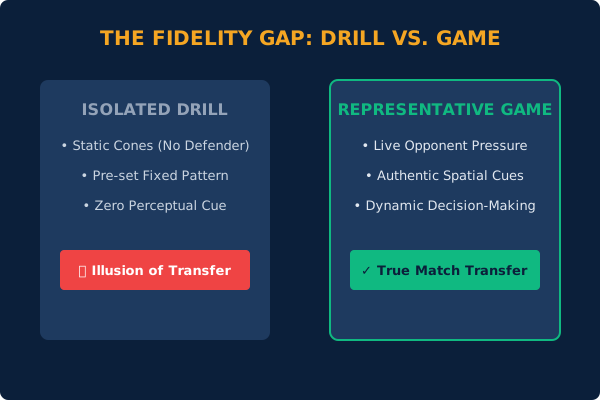
In ecological dynamics, we solve this through Representative Learning Design (RLD). RLD is the practice of ensuring that the training environment preserves the "functional essence" of the game. It’s not about making a drill look like a match; it’s about making sure the perceptual requirements are identical.
Think of a flight simulator. A high-fidelity simulator doesn't just have buttons that look like the real cockpit; it simulates the wind shear, the turbulence, and the erratic behavior of the aircraft. If a pilot only trains in a "perfect" simulator where the air is always still, they will crash the moment they hit a real storm. They have the "technical" skill, but they lack the "perceptual" experience of the storm.
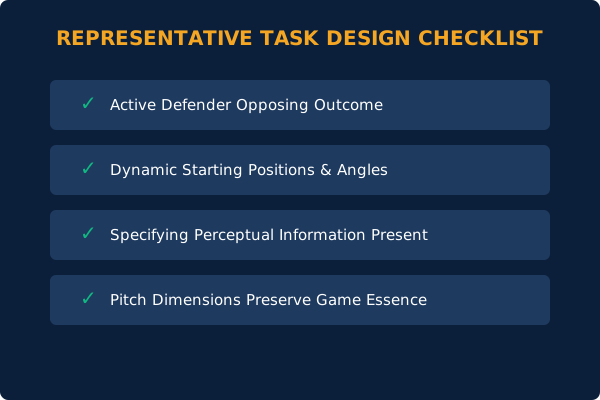
In football, RLD means we stop using "dead" defenders (cones or passive players) and start using "live" opponents who are actively trying to prevent the desired outcome. It means we stop using fixed starting positions and start using dynamic setups where the athlete must first perceive the environment before they can act.
When the information in training matches the information in the game, the Fidelity Gap closes. The player no longer has to "translate" their training into match-day performance; the training is the performance.
Via Negativa: RLD is NOT Just "Playing a Game"
A common misconception is that RLD simply means "stop drilling and just play small-sided games." This is a mistake. Just playing a game is not the same as Representative Design. If you put players in a 5v5 game but the pitch is so small that they can't actually use the tactical solutions you want them to learn, you haven't designed a representative environment; you've just designed a different kind of drill.
RLD is a surgical process. It is the intentional act of identifying the specific perceptual cues required for a skill and ensuring those cues are present in the practice.
If you are training a center-back to play a long diagonal ball, a "game" isn't enough. You need to ensure there is a defender pressing their front, a teammate making a specific overlapping run, and a target area that represents a real attacking opportunity. If any of those "representative" elements are missing, you are once again training a "robotic" response rather than a functional one.
The Master's Eye
The transition to RLD is a journey of intellectual honesty. It is the "Scar Tissue" of the coach who has realized that "clean" drills are often a lie.
We love the look of a perfectly executed drill. It makes us feel like the players are improving. But a "perfect" drill is often a sign that the Fidelity Gap is at its widest. If there are no mistakes, if there is no hesitation, and if every pass is crisp, it means the environment is too simple. It means the athlete is merely repeating a script.
The a-ha moment comes when you realize that a "messy" session—one where players are struggling to find the solution—is actually a higher-fidelity session. The struggle is the signal that the perceptual requirements are real.
True mastery is the ability to design a training session that feels like a match, long before the whistle blows on Saturday. Stop mimicking the game. Start representing it.
Stop Training Robots. Build Adaptive Athletes.
Join our community of forward-thinking coaches applying Ecological Dynamics in high-performance sports.
Explore The Adaptive Athlete