Stop Coaching the Person, Start Coaching the Environment

The secret to rapid skill acquisition isn't found in the athlete's "effort" or "willpower," but in the design of the environment they inhabit. When we stop trying to "fix" the player and start manipulating the constraints of the game, we allow the athlete's natural ability to adapt to do the heavy lifting for us.
You’ve spent years doing it. You see a player struggling with their first touch. You pull them aside. You demonstrate the perfect cushion. You explain the angle of the foot, the relaxation of the ankle, the shift in center of gravity. You do it ten times. They do it ten times. It looks great in the drill. But the moment the game starts and a defender is breathing down their neck, the first touch is back to being a disaster.
You might be thinking: But isn't that my job? If the player is failing, shouldn't I be the one providing the correction?
It feels like the right move. We are conditioned to believe that the coach is the "solution provider." But here is the hard truth: the more you provide the solution, the less the athlete learns how to find it. By focusing on "fixing the person," you are actually bypassing the very mechanism the brain uses to acquire skill.
The Myth of the "Correct" Athlete
For a century, sport has been taught as a series of internal corrections. We treat the athlete like a piece of clay that needs to be molded into a specific shape. We believe that if we can just get the body to move in a "correct" way, the performance will follow.
This is not how learning works.
Learning isn't about replicating a model; it's about solving a problem. This is the core of Ecological Dynamics.
Ecological Dynamics is the study of how an organism (the athlete) adapts to its environment. It suggests that skill is not something "stored" in the head or the muscles, but something that emerges from the relationship between the athlete and the world around them.
Think of a seed. You don't "teach" a seed how to grow into a tree. You don't tell it to "reach for the light" or "push through the soil." Instead, you provide the right soil, the right amount of water, and the right temperature. The growth is an inevitable response to the environment.
In sport, the "growth" is the skill. The "soil" is your training design.
The Power of Constraints: Your Real Toolset
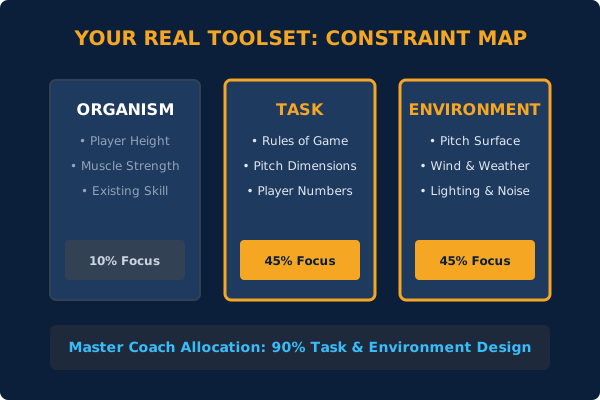
If we stop coaching the person, what are we actually doing? We are manipulating Constraints.
A constraint is anything that limits or encourages a specific behavior. In ecological dynamics, we look at three types: 1. The Organism: The athlete's height, strength, and existing skill. 2. The Environment: The wind, the surface of the pitch, the lighting. 3. The Task: The rules of the game, the size of the pitch, the number of players.
Most coaches spend 90% of their time trying to change the Organism (telling the player to change their movement). The master coach spends 90% of their time changing the Task and the Environment.
If you want your defenders to communicate more, don't give them a lecture on "leadership" or "talking." Instead, put on blindfolds for two of the defenders. Suddenly, communication isn't a "suggestion"—it's the only way to survive the drill. The behavior emerges because the environment demands it.
Via Negativa: What Ecological Coaching is NOT
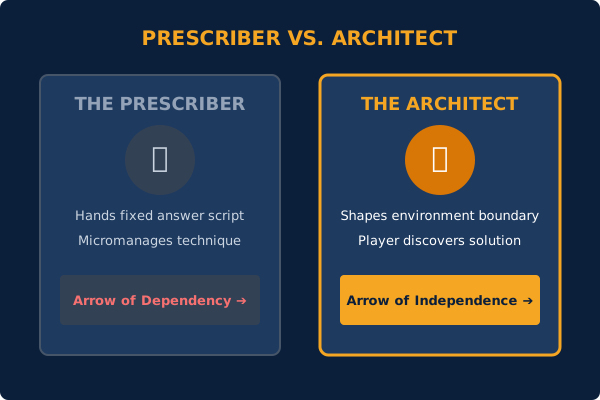
To understand this approach, we must define what it is not.
Ecological coaching is not "leaving the players to their own devices" or "doing nothing." It is not a lazy approach to coaching. In fact, it is much harder. It requires you to spend hours thinking about the design of the session before you ever step on the grass.
It is not about "letting the game be the teacher" in a chaotic, unplanned way. It is about Representative Learning Design (RLD)—intentionally creating a training environment that preserves the "essence" of the game.
If you are running a 5v5 game but the players are just standing around waiting for the ball, you haven't designed an ecological environment; you've just played a small game. A truly ecological designer would shrink the pitch or add a "shot clock" to force the players to perceive new affordances and find new solutions.
The Master's Eye
The transition to this mindset is a journey of letting go. It is the "Scar Tissue" of the coach who has realized that their own voice is often the biggest obstacle to their player's growth.
It is humbling to realize that the most effective thing you can do is often to stop talking and start adjusting the boundaries of the square. It is a shift from being the "Sage on the Stage" to being the "Guide on the Side."
True mastery is the ability to create a world where the athlete cannot help but succeed. Stop trying to build the perfect player. Start building the perfect environment.
Stop Training Robots. Build Adaptive Athletes.
Join our community of forward-thinking coaches applying Ecological Dynamics in high-performance sports.
Explore The Adaptive Athlete